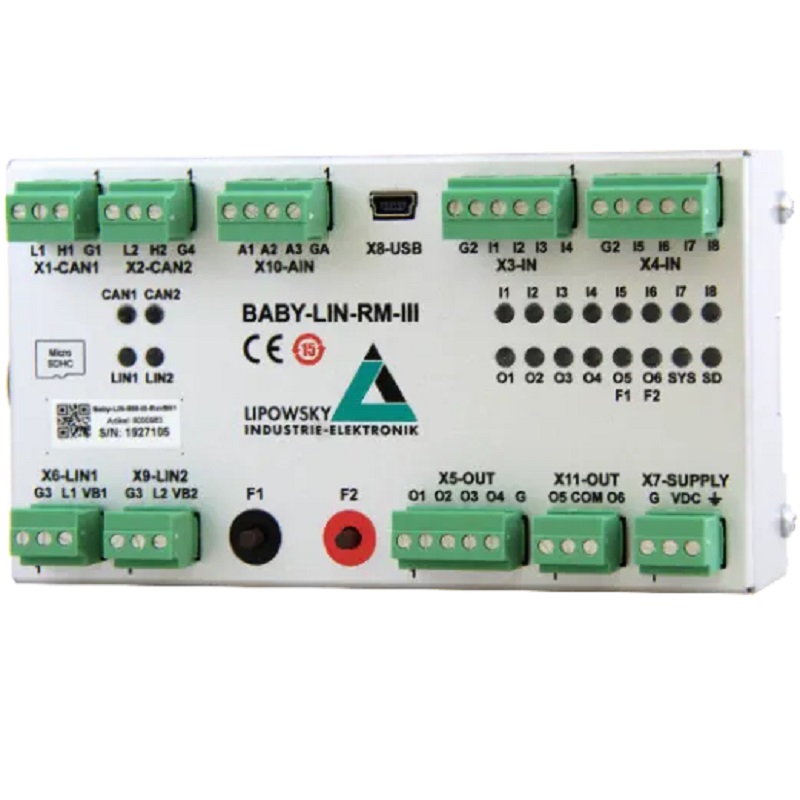
BABY-LIN-RM-III
Part No.: MPLPS-BABY-LIN-RM-III
LIN- and CAN-Bus simulator with digital I/O interface
Product Description
Description
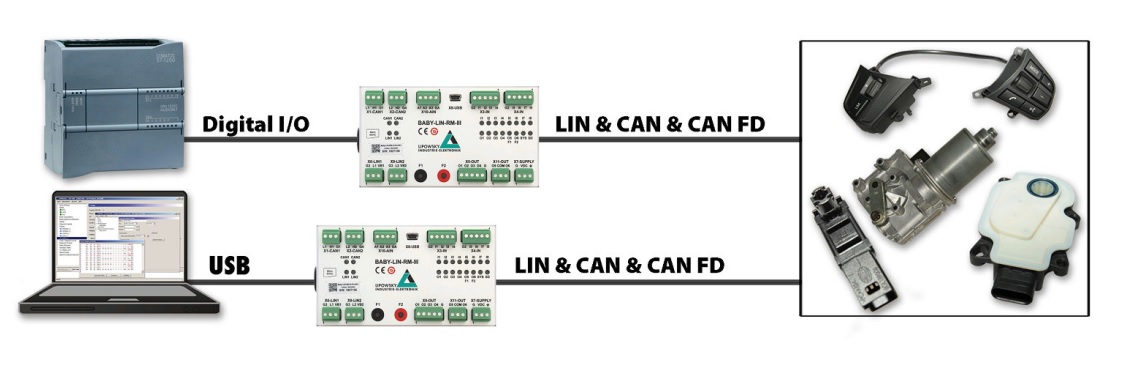
The Baby-LIN-RM-III allows LIN and CAN Bus equipped devices to be controlled using a standard personal computer. After installing the supplied LINWorks software, you can connect the Baby-LIN-RM-III to an available USB port and access LIN and CAN Bus devices via LINWorks or custom applications using the Baby-LIN-DLL.
In addition, LIN and CAN devices can be controlled and evaluated using inputs and outputs only. This enhances PLC (Programmable Logic Controller)-based testing facilities with LIN or CAN Bus capabilities without significant effort. This can be particularly beneficial for facilities performing long-term testing.
The Baby-LIN-RM-III provides 8 digital inputs, 3 analog inputs and 6 digital outputs. Two of the digital inputs can read, scale and map PWM (Pulse Width Modulation) signals to bus signals.
Furthermore, the module's digital outputs can be controlled by bus signal values. For example, an output can be set when a signal equals, does not equal, is greater than or less than a reference value. It can also be tested whether a specific signal value is within a defined range.
All digital outputs can also be configured to output PWM signals.
In addition, the Baby-LIN-RM-III offers two programmable buttons. They can, for example, be used to start and stop LIN or CAN Bus communication. They can also be assigned to many other functions.
The CAN Bus interfaces (1) of the Baby-LIN-RM-III support CAN FD and are backward compatible with CAN-HS. Both CAN Bus interfaces feature switchable termination resistors. One of the interfaces can be switched to a Fault Tolerant CAN-LS interface.
The Baby-LIN-RM-III has a microSD card slot (1), which can be used for logging purposes. The associated LED indicates the logging status as well as the firmware update and boot status.
The Baby-LIN-RM-III supports LIN Bus voltages in the range of 8-26 VDC. All communication interfaces (LIN Bus, CAN Bus and USB) are galvanically isolated, eliminating interference between the PC and the board electronics.
Only four digital outputs use the ground of the board's logic supply. Two of the digital outputs are galvanically isolated.
The Baby-LIN-RM-III includes its own 32-bit microcontroller, which handles all time-critical tasks of the LIN Bus protocol.
The device firmware is field-updatable, allowing the device to easily adapt to changes in bus specifications and upcoming new system features.
The Baby-LIN-RM-III supports SDF-V3. This new generation of SDF enables features such as multiple bus sections, conditional macro commands, new system variables, new CRC functions and sub-macro calls.
(1) This function requires additional software license(s). See the Ordering Information for details.
Operation Mode
Any situation that requires communication with a LIN or CAN device is a potential field of application for the Baby-LIN-RM-III. It is a versatile tool that can be used in research laboratories, test departments and production environments (EOL applications).
- Monitor and log all frames on the bus without the need for an SDF. If an SDF is available, signal values can also be monitored.
- Control the bus via the LINWorks software or customer-specific applications using the Baby-LIN-DLL.
- Program and store freely programmable command sequences in the Baby-LIN-RM-III to operate it as a standalone device without the need for a PC. This allows a bus-driven ECU to be operated during durability testing or EOL applications without a connected PC.
Simulation Modes
The Baby-LIN-RM-III is able to simulate different configurations of LIN Bus and CAN Bus nodes. It is possible to simulate any number of nodes, ranging from none to all. These are some typical configurations:
- LIN Bus: Simulate the LIN Bus Master to operate Slave nodes.
- LIN Bus: Simulate any number of LIN Bus Slave nodes.
- LIN Bus: Simulate all nodes and therefore the complete communication on the bus.
- CAN Bus: Simulate any number of CAN Bus nodes.
- LIN Bus and CAN Bus: Simulate all but one node and realize a Residual Bus Simulation.
- LIN Bus and CAN Bus: Simulate no nodes to monitor the bus communication only.
Simulations for the LIN Bus and CAN Bus can be performed simultaneously.
LIN- and CAN-Bus Properties
The used LIN Driver supports bus voltages of 8-26 VDC and can be used up to 115200 Baud. This allows even nodes that operate outside the standard limits of the LIN specifications to be controlled with the Baby-LIN-RM-III.
Supported LIN versions are V1.2, V1.3, ... V2.2. The Pull-up resistor of the LIN Bus Driver is switched to 1 kOhm when the Master node is emulated and to 30 kOhm when only Slave nodes are emulated.
Both CAN Bus interfaces of the Baby-LIN-RM-III are designed as CAN FD interfaces according to ISO 11898-1:2015 with an MCP2562FD Driver. They support data Baud rates up to 8 Mbit/s.
Both CAN Bus interfaces can be used as CAN High-Speed interfaces according to ISO 11898.
The second CAN Bus interface can be switched to a Fault Tolerant Low-Speed physical layer according to ISO 11519 with a TJA1055 Driver.
The maximum supported signal cable length for the LIN Bus and CAN Bus is 30 m, but may be shorter depending on the bus assembly.
LINWorks Suite
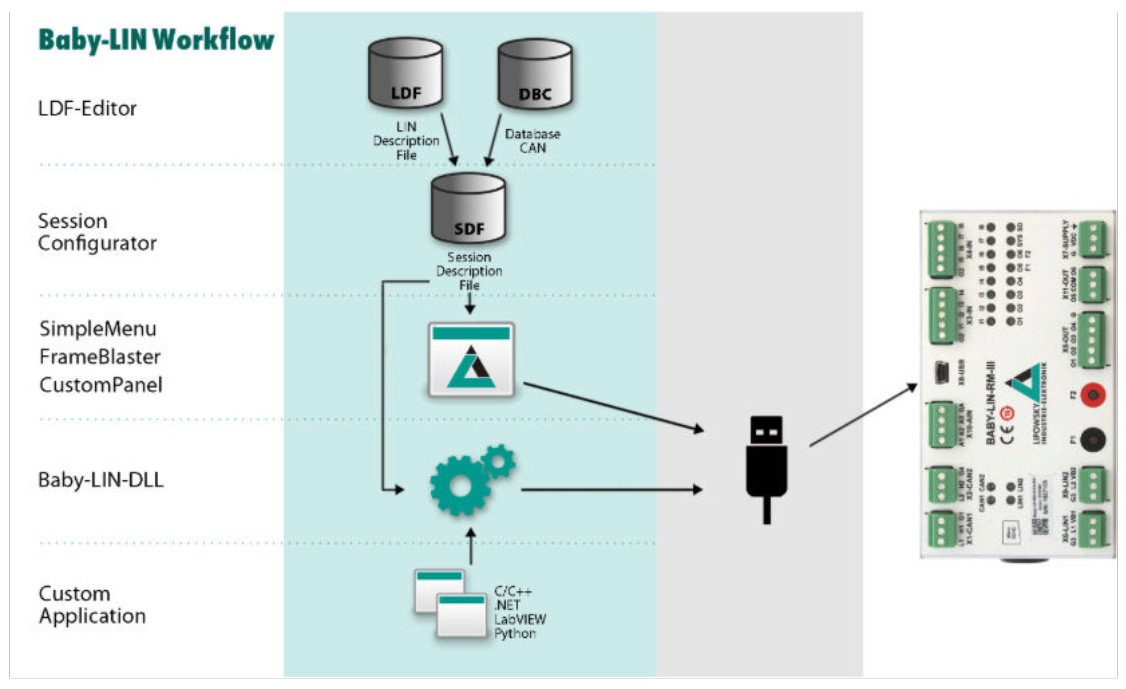
The purchase of a Baby-LIN-RM-III includes a license to download the LINWorks suite. This suite is a collection of PC software that supports you throughout the entire workflow.
LDFEdit allows the inspection, creation and editing of an LDFile (LIN Description File).
SessionConf allows the inspection, creation and editing of an SDFile (Session Description File), and supports importing LDF files for LIN Bus simulation and DBC files for CAN Bus simulation. It defines everything required for a complete simulation of each available bus, such as which nodes are available on each bus and which nodes should be simulated by the Baby-LIN-RM-III. It also allows application logic to be defined. This programming capability is available for each device out of the box.
SimpleMenu is used to establish a connection to the Baby-LIN-RM-III, upload SDF files, change the device target configuration, control the bus, and monitor frames and signals on the bus. Even without an LDFile, DBC file or SDFile, the bus can be monitored and frames can be logged.
Baby-LIN-DLL allows customers to create their own applications and use all features of the Baby-LIN-RM-III, such as controlling and monitoring the LIN Bus and CAN Bus interfaces. Baby-LIN-DLL is a native C/C++ DLL and is available for Windows, Linux and Raspberry Pi. Wrappers for .NET, Python, VB6 and LabVIEW are also available. Examples are provided for all supported programming languages.
LogViewer can display and convert log files generated by the Baby-LIN-RM-III and SimpleMenu.
The LINWorks software runs on 32-bit and 64-bit versions of Windows 10 and higher.
Specifications
Device
- CPU: ARM Cortex-M7, 300 MHz
- Memory: 32 MB RAM
- 6 red/green multicolor LEDs: Indicate device status, microSD card status, and LIN/CAN Bus states
- 2 LEDs: Can be used as digital output indicators, push button indicators, or freely programmable LEDs
- 12 LEDs: Used as signal indicators for digital inputs and outputs
- 2 freely programmable push buttons
- Real-time clock with battery backup
- Power supply: 7-32 VDC
- Power supply via 3-pin connector (MC 1,5/3-ST-3,81)
- Maximum current consumption: 70 mA @ 24 VDC
- Galvanic isolation of all communication interfaces (LIN Bus, CAN Bus and USB), except for 4 of the 6 digital outputs
Interface: LIN
- Up to 2 LIN Bus interfaces available
- 1 LIN Bus interface available by default
- 1 LIN Bus interface optionally available on the hardware but not activated; voucher code required
- LIN Bus connection via 3-pin connector (MCVR 1,5/3-ST-3,81)
- LIN Bus supply voltage: 8-26 VDC
- LIN Bus Baud rate: up to 115200 Baud (supports protocols outside the LIN specification)
- Supported LIN versions: V1.2, V1.3, ... V2.2
- Supported LIN-related protocols: Cooling and SAE J2602
- Maximum signal cable length for LIN Bus: 30 m
Interface: CAN
- 2 CAN FD Bus interfaces according to ISO 11898-1:2015 with data Baud rates up to 8 Mbit/s, available on the hardware but not activated; voucher code required
- Both CAN FD Bus interfaces can be used as High-Speed CAN (CAN-HS) interfaces according to ISO 11898
- CAN Bus driver for CAN FD and CAN-HS: MCP2562FD
- One CAN FD Bus interface can be used as a Fault Tolerant Low-Speed CAN (CAN-LS) interface according to ISO 11519; voucher code required
- CAN Bus driver for CAN-LS: TJA1055
- CAN FD Bus connection via 3-pin connector (MCVR 1,5/3-ST-3,81)
- Maximum Baud rate: CAN FD: 8 Mbit/s, CAN-HS: 1 Mbit/s, CAN-LS: 125 kbit/s
- Maximum signal cable length for CAN Bus: 30 m
Interface: Digital I/O
- 8 digital inputs
- 4 digital Low-Side outputs
- 2 electrically isolated digital outputs
- Digital I/O available via 3 x 5-pin connectors (MCVR 1,5/5-ST-3,81) and 1 x 3-pin connector (MCVR 1,5/3-ST-3,81)
- 2 digital inputs can be used to read PWM signals
- 4 digital outputs can be used to output PWM signals
Interface: Analog I/O
- 3 electrically isolated analog inputs
- Measuring range: up to 25 V
- Voltage tolerance: up to 33 V
- Analog I/O available via 4-pin connector (MC 1,5/4-ST-3,81)
Interface: microSD Card
- Supported card types: microSD, microSDHC
- Supported file systems: FAT-32, FAT-16
- Maximum card size: 32 GB
- The microSD card slot is planned for future logging functions. It is currently without function.
Case
- Degree of protection: IP20
- Operating temperature: -20° to +60°C
- Weight: 250 g
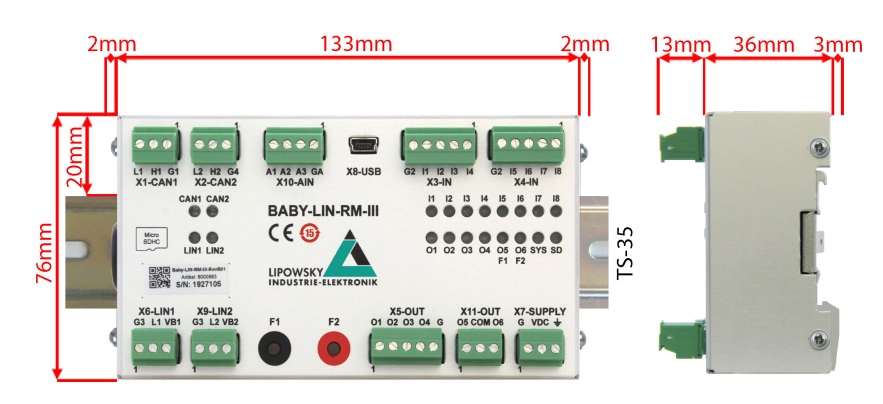
- Case dimensions [mm]: 136 x 76 x 36 (L x W x H), excluding connectors, buttons and top-hat rail mounting adapter
- Mounting: Top-hat rail (TS 35)
Dimension Drawing
Hardware Requirements
The following hardware is required to operate the Baby-LIN-RM-III:
-
A PC with about 200 MB of free hard drive space
- Required for the installation of the LINWorks software. Please check the software requirements and applicable use cases.
-
A free USB port
- Required to transfer SDF files to the Baby-LIN-RM-III and for firmware updates.
-
Power supply: 7-32 VDC, min. 2 A
- Required to supply power to the Baby-LIN-RM-III.
Software Requirements
The LINWorks software requires one of the following operating systems:
- Windows XP
- Windows Vista (32-bit and 64-bit)
- Windows 7 (32-bit and 64-bit)
- Windows 8 (32-bit and 64-bit)
- Windows 10 (32-bit and 64-bit)
- Windows 11 (32-bit and 64-bit)
LINWorks workflow
Scope of Delivery
The delivery of a Baby-LIN-RM-III system includes the following components:
- Baby-LIN-RM-III device
- USB 2.0 cable, 1.5 m, Type A to Mini-B
-
Plug components:
- 6 x 3-pin plugs with screw connection (MCVR 1,5/3-ST-3,81)
- 1 x 4-pin plug with screw connection (MCVR 1,5/4-ST-3,81)
- 3 x 5-pin plugs with screw connection (MCVR 1,5/5-ST-3,81)
- Download license for the LINWorks Suite (includes LINWorks PC software, USB Driver, example files and documentation)
Additional Hardware Recommendation
| Item Number | Item | Description |
|---|---|---|
| 8000960 | IF-OUT-N2P-4Ch | Adapter to convert the 4 Low side Outputs (NPN) into high side outputs (PNP). |
.jpg)
This output adapter converts the Low-Side digital outputs of the Baby-LIN-RM-III into High-Side digital outputs. These High-Side outputs are commonly required by PLCs.
| Level | Baby-LIN-RM-III | Output adapter |
|---|---|---|
| Logic 0 | High impedance | High impedance |
| Logic 1 | 0 VDC | 24 VDC |
The power supply of the Baby-LIN-RM-III can also be used to power the Baby-LIN-RM-III output adapter. Therefore, the power supply can be passed through the adapter.
Since Rev. C, PWM signals are converted with virtually no distortion.
Typical Applications
- Connection to a PLC. No additional resistors are required.
- Connection of loads that must be switched against 24 VDC.
- Current applications of up to 4 A on a single output, when only one output is used.
Electrical Characteristics
- Power supply: 8-33 VDC
- Current consumption without load: 11 mA @ 12 VDC, 22 mA @ 24 VDC
- Maximum total output current: 4 A (internally protected)
Case
- Operating temperature: -20° to +65°C
- Weight: 39 g
- Case dimensions [mm]: 45 x 77 x 23 (L x W x H)
Ordering Information
| Item Number | Item | Description |
|---|---|---|
| 8000983 | Baby-LIN-RM-III | Multibus simulation device with I/O interface |
Optional
Hardware Components
| Item Number | Item | Description |
|---|---|---|
| 8000960 | IF-OUT-N2P-4Ch | 4 channel low to high side converter for the Baby-LIN-RM-III. |
| 2900130 | 3V CR1220 Lithium button cell | This button cell is used to power the RTC of the Baby-LIN-RM-III. A new cell can power the RTC for more than 9 years. |
| 3500701 | USB 2.0 Cable, 1.5 m Type A to Mini-B | This cable connects the Baby-LIN-RM-III to a PC. |
| 3021130 | MCVR 1,5/3-ST-3,81 | 3-pin plug component with screw connection and tension sleeve. Cable outlet perpendicular to the plug-in direction. Screw direction parallel to the plug-in direction. |
| 3021140 | MCVR 1,5/4-ST-3,81 | 4-pin plug component with screw connection and tension sleeve. Cable outlet perpendicular to the plug-in direction. Screw direction parallel to the plug-in direction. Used only by the IF-OUT-N2P-4Ch adapter, not by the Baby-LIN-RM-III itself. |
| 3021150 | MCVR 1,5/5-ST-3,81 | 5-pin plug component with screw connection and tension sleeve. Cable outlet perpendicular to the plug-in direction. Screw direction parallel to the plug-in direction. |
Voucher Codes
| Item Number | Item | Description |
|---|---|---|
| 8002150 | Option BL-Security-Access-Gateway | License code for the Security Access Gateway Application to connect Security DLLs to SDFs executed on a Baby-LIN-RM-III. |
| 8000891 | Option BL-Webasto KLine | License code for software activation of the special function for the Webasto K-Line Protocol. Written approval from Webasto is required. |
| 8000853 | Option BL-LIN-2 | License code for the Baby-LIN-RM-III to activate the second LIN Bus interface. |
| 8000810 | Option BL-CAN-1-HS | License code for the Baby-LIN-RM-III to activate CAN-HS (High-Speed) support for the first CAN Bus interface. |
| 8000991 | Option BL-CAN-1-FD | License code for the Baby-LIN-RM-III to activate CAN FD (Flexible Data Rate) support for the first CAN Bus interface. |
| 8000990 | Option BL-CAN-2-HS | License code for the Baby-LIN-RM-III to activate CAN-HS (High-Speed) support for the second CAN Bus interface. |
| 8000992 | Option BL-CAN-2-FD | License code for the Baby-LIN-RM-III to activate CAN FD (Flexible Data Rate) support for the second CAN Bus interface. |
| 8000820 | Option BL-CAN-2-LS | License code for the Baby-LIN-RM-III to activate CAN-LS (Low-Speed) support for the second CAN Bus interface. |
| 8000943 | Option BL-microSD-Card | License code for the Baby-LIN-RM-III to activate logging to the microSD card. |
Software Components
| Item Number | Item | Description |
|---|---|---|
| 9004210 | Customer-Specific Installation | Installation of a customer-specific SDFile version and/or installation of a license activation key. |
| 9103010 | LINWorks CD | LINWorks archive containing PC software for all Baby-LIN products, provided on physical media (CD). |
Note:
2. EOL products will not be notified separately.
3. Product images are for reference only. Actual products may vary depending on the version or specifications.
4. Product information, specifications, and availability are subject to confirmation at the time of order.