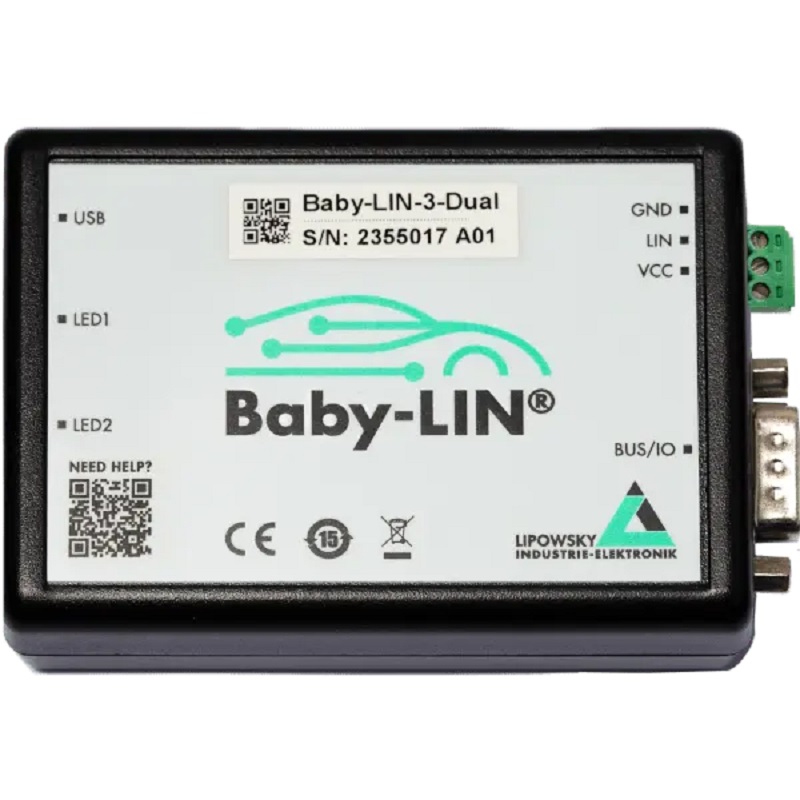
BABY-LIN-3-Dual
Part No.: MPLPS-BABY-LIN-3-Dual
LIN & CAN-Bus simulation device with USB interface
Product Description
Description
The Baby-LIN-3-Dual is part of the third generation of Baby-LINs introducing new and more powerful features.
All devices are powered by a 480MHz Cortex M7 core increasing the possible speed by 60% in comparison to the previous generation, allowing faster SDF execution and leaving reserves for new software features. To emphasize this performance leap the devices are also now equipped with a native high-speed (480MBit/s) USB connection and a USB-C connector, making it more convenient and reliable to use. We also further improve the usability of our devices by offering a male SUB-D9 connector for all bus signals, allowing the user to secure the connector to the device and giving more flexibility for upgrades from one device to another. Of course, we are upholding our compatibility guidelines for previous generations so all devices have still the established three pin plug for the LIN bus.
The power for the Baby-LIN-3-Dual can be supplied either from the USB or the LIN-Bus side. If the device is powered by the LIN-Bus it can be operated without the need for a PC. All communication interfaces (LIN- and CAN-Bus and USB) are galvanic isolated, eliminating interference between the PC and the board electronics.
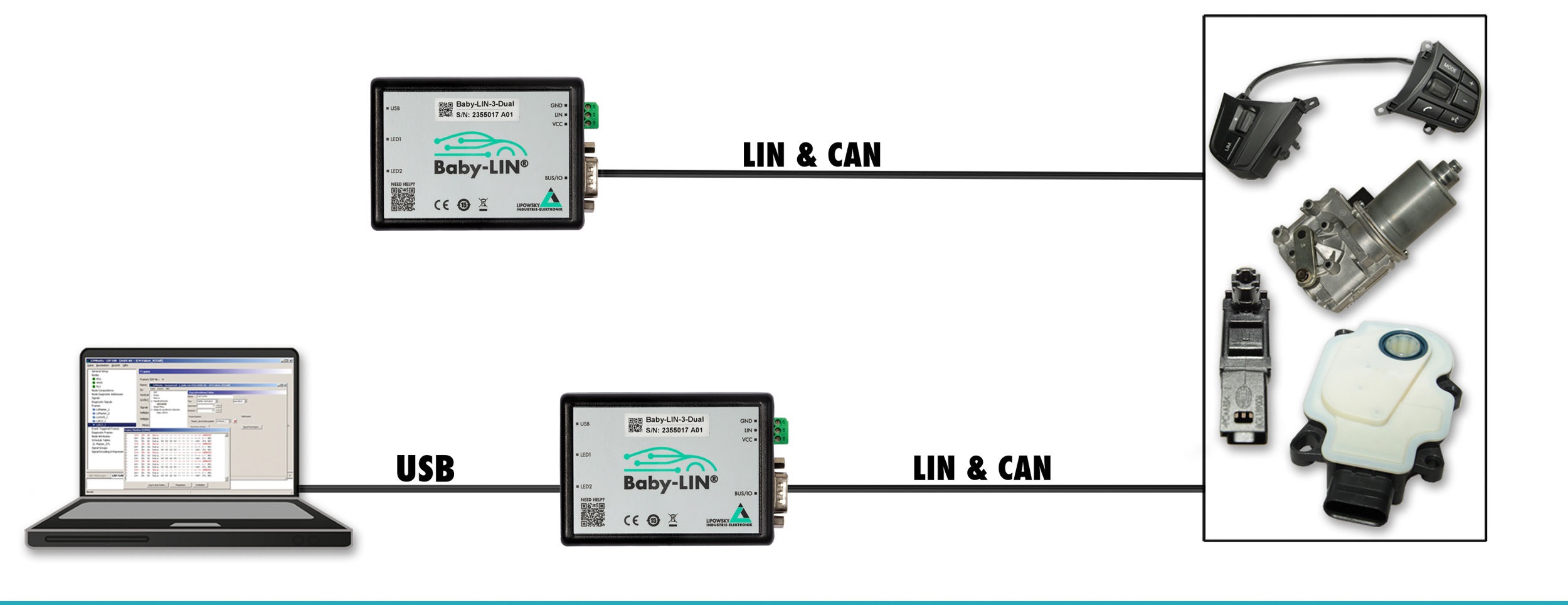
The Baby-LIN-3-Dual allows controlling LIN- and CAN-Bus equipped devices by using a standard personal computer. After installation of the supplied LINWorks software, you can connect the Baby-LIN-3-Dual to a free USB port, and access the LIN- and CAN-Bus devices via LINWorks or custom programs by using the Baby-LIN-DLL.
Two red/green colored LEDs on the side show device information but can also be utilized by the user for other needs.
Besides one LIN interface the Baby-LIN-3-Dual also includes one already activated CAN-HS bus with a switchable termination resistor. The signals on the SUB-D9 connector are placed in accordance with CiA DS102. The CAN interface also supports CAN-FD with up to 8MBit/s (1).
The device firmware is field updateable, so the changes of bus specification or upcoming new system features can be adapted easy.
The Baby-LIN-3-Dual supports SDF-V3 and is prepared for SDF-V4.
(1) Function requires additional software license(s). See Ordering information for more details.
Operation mode
Any situation that requires communication with a LIN- and CAN-Bus device is a potential field of application for a Baby-LIN-3-Dual . It is a versatile tool that can be used in research laboratories, test departments and production (EOL applications).
- Monitor and log all frames on the bus without the need for a SDF. If a SDF is available signal values can also be monitored.
- Control the bus via the LINWorks software or customer specific applications by using the Baby-LIN-DLL.
- Program and store free programmable command sequences in the Baby-LIN-3-Dual to run it as a stand-alone device without the need for a PC. Thus you can run a bus driven ECU in a durability test or EOL applications without any PC connected.
Simulation modes
The Baby-LIN-3-Dual is able to simulate different configurations of LIN- and CAN-Bus nodes. It is possible to simulate any number of nodes ranging from none to all.These are some typical configurations:
- LIN-Bus: Simulate the LIN-Bus master to operate slave nodes.
- LIN-Bus: Simulate any number of LIN-Bus slave nodes.
- LIN-Bus: Simulate all nodes and therefor the complete communication on the bus.
- CAN-Bus: Simulate any number of CAN-Bus nodes.
- LIN- and CAN-Bus: Simulate all but one node and realize a residual bus simulation.
- LIN- and CAN-Bus: Simulate no node to monitor the bus communication only.
Simulations for the LIN- and CAN-Bus can be done simultaneously
LIN- and CAN-Bus properties
The used LIN driver supports bus voltages of 8-26 VDC and can be used up to 115200 Baud. That way even nodes that operate outside the standard limits of the LIN specifications can be controlled with the Baby-LIN-3-Dual. Supported LIN-versions are V.1.2 to V.2.2. The pull-up resistor of the LINBus driver is internally switched to 1 kOhm, if the master node is emulated. The CAN-Bus interfaces of the Baby-LIN-3-Dual are designed as CAN-FD interfaces according to ISO-11898-1:2015. They support data baudrates up to 8 MBit/s. A internal 120 termination resistor can be turned on and off by software.
LINWorks suite
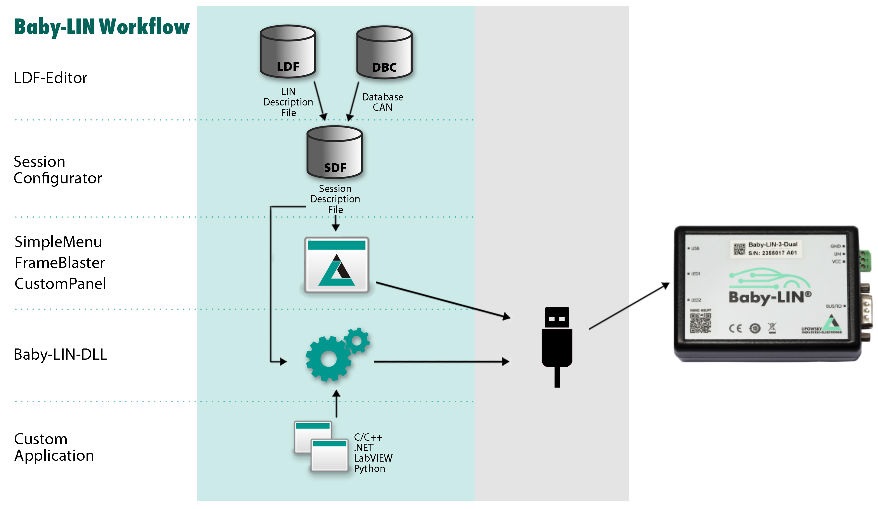
The purchase of a Baby-LIN-3-Dual includes the license to download the LINWorks suite. This suite is a collection of PC software that supports you during the whole workflow.
The LDFEdit allows the inspection, creation and edit of a LDFile (LIN Description File).
The SessionConf allows the inspection, creation and edit of a SDFile (Session Description File) and features a file import for LDFiles (for LINBus simulation) and DBC files (for CAN-Bus simulation). It defines everything needed for a complete simulation of each available bus, e.g. which nodes on each bus are available and which nodes should be simulated by the Baby-LIN-3-Dual . Moreover it allows defining an application logic. This programming ability is available for each device out of the box.
The SimpleMenu is used to establish a connection to the Baby-LIN-3-Dual and upload SDFiles, change the device target configuration, control the bus and monitor the frames and signals on the bus.
Even without a LDFile, DBC file or SDFile the bus can be monitored and the frames can be logged.
The Baby-LIN-DLL allows customers to create their own application and use all features of the Baby-LIN-3-Dual like controlling and monitoring the LIN- and CAN-Bus interfaces. The Baby-LIN-DLL is a native C/C++ DLL. It is available for Windows, Linux and RaspberryPi. Wrapper for NET, Python, VB6 and LabView are available. Of course we provide examples for all supported languages.
The LogViewer can show and convert the log files of the Baby-LIN-3-Dual as well as the SimpleMenu.
The LINWorks software runs on 32 and 64 bit Windows 10 or higher versions.
Specifications
Device
- Power supply: 8-26 VDC
- Power supply via 3 pin connector (MC 1,5/ 3-ST-3,81) or male SUBD9 connector
- Galvanic isolation of the communication interfaces and USB plug side
- CPU: ARM Cortex-M7, 480 MHz
- Memory: 32 MB RAM
Interface: USB Device
- USB 2.0 high-speed (480Mbit/s) interface
- Connection via USB-C plug
Interface: LIN
- 1 LIN-Bus interface available
- 1 Red/green LED (LED1) to show state of the LIN-Bus and the supply voltage
- LIN-Bus connection via 3 pin connector (MCVR 1,5/ 3-ST-3,81) or SUB-D9 connector
- LIN-Bus supply voltage: 8-26 VDC
- LIN-Bus baud rate: up to 115200 Baud (Support of protocols outside of the LIN specification)
- Supported LIN versions: V1.2, V1.3,...V2.2
- Supported LIN related protocols: Cooling and SAE J2602
- Maximum signal cable length for LIN-Bus: 30 m
Interface: CAN
- 1 CAN-HS-Bus interfaces according to ISO-11898 with up to 1Mbit/s.
- Upgradeable to CAN-FD-Bus according to ISO-11898-1:2015 with data baudrates up to 8 MBit/s, voucher code required.
- CAN-Bus connection via SUB-D9 connector, pin layout according to CiA DS102
- 1 Red/green LED (LED2) to show state of the CAN-Bus
- Internal switchable 120R termination resistor
- Galvanic isolation from LIN-Bus and USB
- Maximum signal cable length for CAN-Bus: 30m
Case:
- Degree of protection: IP20
- Operating temperature: -20°- +80°Celsius
- Weight: 95 g
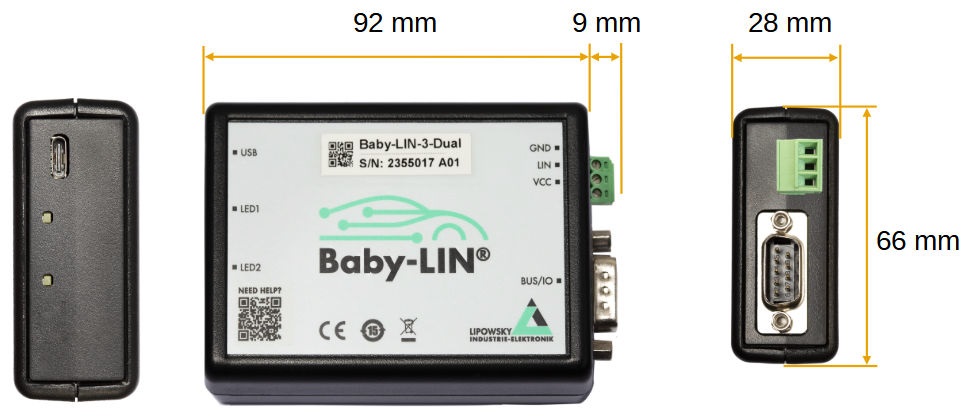
- Case dimensions [mm]: 92 x 66 x 28 (L x W x H), external connectors not included.
Pin Description
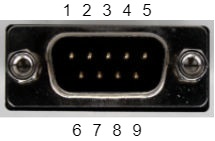
| Pin | Signal | Description |
|---|---|---|
| 1 | n.c. | no connection, leave unconnected |
| 2 | CAN-L | Low line of the CAN interface |
| 3 | CAN-GND | Ground for CAN interface |
| 4 | 1.LIN | First LIN-Bus |
| 5 | n.c. | no connection, leave unconnected |
| 6 | GND | Common ground |
| 7 | CAN-H | High line of the CAN interface |
| 8 | 1.LIN | First LIN-Bus |
| 9 | VCC | Supply input for the device |
Dimension Drawing
Hardware Requirements
The following hardware is required to operate the Baby-LIN-3-Dual :
A PC with about 200 MB free hard drive space
- Required for the installation of the LINWorks software. Please check the software requirements and use cases.
A free USB port
- Required to transfer SDFiles to the Baby-LIN-3-Dual and for firmware updates.
Software requirements
The LINWorks software requires one of the following operating systems:
- Windows 10 (32 and 64 Bit)
- Windows 11 (x86 and 64 Bit)
LINWorks workflow
Scope of delivery
The delivery of a Baby-LIN-3-Dual systems includes the following components:
- Baby-LIN-3-Dual device
- USB-C 2.0 cable, 1m, Type A to type C
- One 3-pin plug with screw connection (MC 1,5/3-ST-3,81)
- One SUB-D9 female plug with solder cups
- Download license for the LINWorks Suite (includes LINWorks PC software, USB-driver, example files and documentations)
Ordering Information
| Item Number | Item | Description |
|---|---|---|
| 8001023 | Baby-LIN-3-Dual | LIN- and CAN-Bus simulation device with USB interface |
| 3500720 | USB 2.0 cable, 1m Type A to type C | This cable connects the Baby-LIN-3 to a PC. |
| 3021303 | MC1,5/3-ST-3,81 |
3-pin plug component, screw connection with tension sleeve. Cable outlet parallel to plugin direction. Screw direction vertical to plugin direction.
|
| 3040330 | Female SUB-D9 plug |
SUB-D9 female plug with solder cups to connector the male SUB-D9 plug of the Baby-LIN-3.
|
Optional
voucher codes
| Item number | Item | Description |
|---|---|---|
| 8002150 | Option BL-Security-Access-Gateway |
License code for the Security Access Gateway Application to connect Security DLL’s to SDF executed on a Baby-LIN-3-Dual .
|
| 8000891 | Option BL-Webasto KLine |
License code for software activation of special function of Webasto K-Line Protocol, need a written approval of Webasto.
|
| 8000991 | Option BL-CAN-1-FD |
License code for Baby-LIN-3 to activate CAN-FD (Flexible Data Rate) support for the CAN-Bus interface.
|
software components
| Item number | Item | Description |
|---|---|---|
| 9004210 | Customer specific installation | Installation of customer specific SDFile version and/or installation of license activation key. |
| 9103010 | LINWorks CD | The LINWorks archive with PC software for all Baby-LIN products on a physical medium (CD). |
Note:
2. EOL products will not be notified separately.
3. Product images are for reference only. Actual products may vary depending on the version or specifications.
4. Product information, specifications, and availability are subject to confirmation at the time of order.